


Inside out: A better way to design drugs?
Project investigating unconventional approach receives Haberecht Wildhare-Idea Research Grant

What if a therapy’s biological target, such as a protein, could help design its own drug?
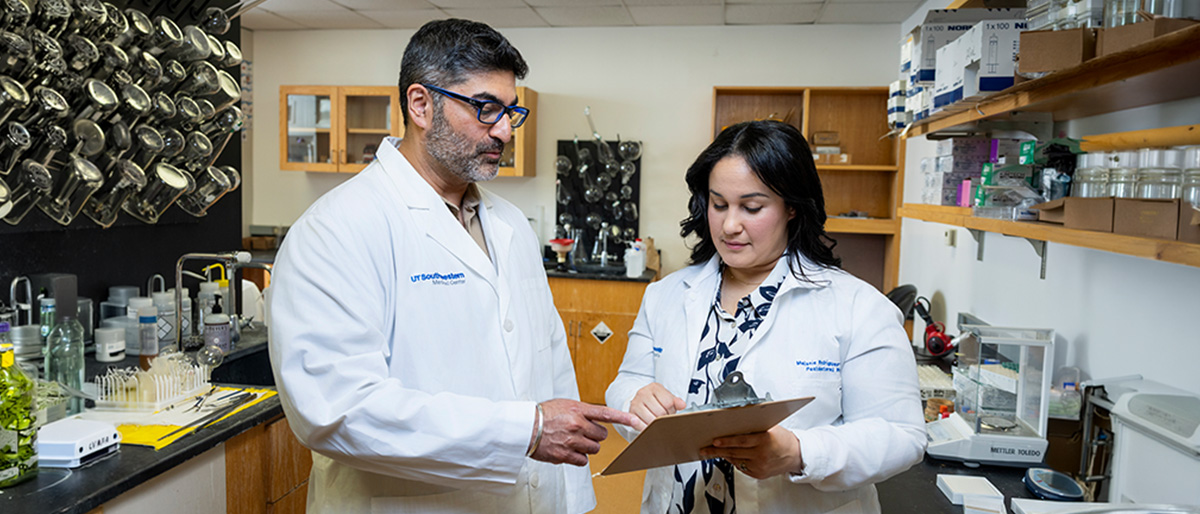
Uttam Tambar, Ph.D., Professor of Biochemistry, and Melanie Rodriguez, Ph.D., a postdoctoral researcher in his lab, pondered that question when they were brainstorming better ways to develop drugs.
“Traditionally, drug discovery involves designing and testing thousands of molecules to find one that binds to a biological target, such as a protein involved in disease,” Dr. Tambar said. “In our proposal, we are asking a fundamentally different question: What if the biological target itself could assist in producing its own drug?”
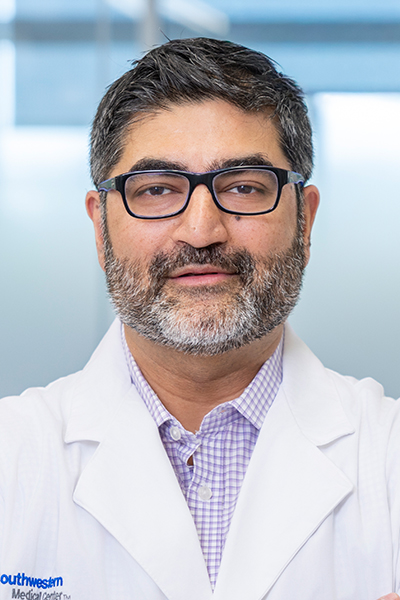
This strategy, which turns conventional methods upside down, earned Dr. Tambar the 2026 Haberecht Wildhare-Idea Research Grant and the chance to bring his proposal, “When the Target Builds the Inhibitor: Enzyme-Directed Assembly of Drugs,” closer to reality.
“While it might seem harebrained, ultimately, this approach could change how some drugs are discovered in the future,” Dr. Tambar said.
That’s exactly what the Haberecht Wildhare-Idea Research Grant is all about. The UT Southwestern Graduate School of Biomedical Sciences selects up to two winners each year to receive this $30,000 grant to pursue “wild hare” ideas considered too speculative to be funded by traditional sources – but if proven would be the basis for a giant step forward in biomedical research. The grant program was founded by and honors the life and legacy of the late Rolf Haberecht, Ph.D., M.B.A., a Southwestern Medical Foundation Trustee and longtime supporter of UT Southwestern.
Dr. Tambar’s idea was chosen for funding by an ad hoc faculty committee from 32 proposals submitted by UTSW faculty, postdoctoral scholars, and graduate students.
The research focuses on using binding pockets in proteins to help build new drug molecules. Instead of testing fully made compounds, the Tambar Lab starts with small chemical pieces that can combine, and when they enter the protein’s binding pocket, it guides them to join into a new molecule that fits well and can block the protein’s activity.
“We hope to take advantage of a perfect alignment of two molecules in a protein’s binding pocket to form a new molecule that can be a starting point to discover a new drug,” he said.
Instead of testing premade drug candidates, Dr. Tambar plans to create small, reactive molecular fragments that combine with each other when they are bound to their protein targets.
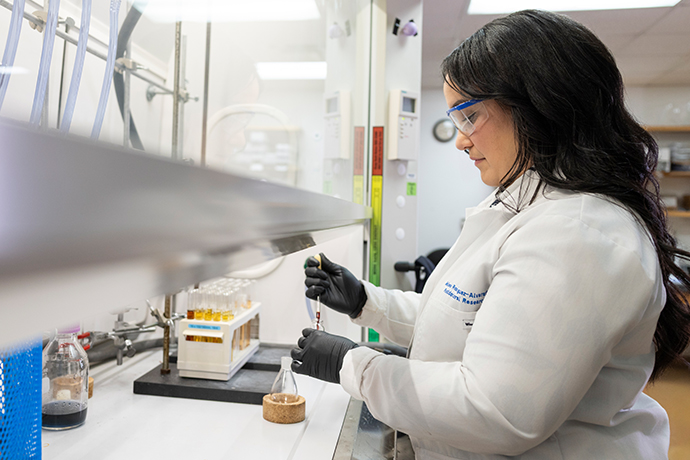
To test this idea, Drs. Tambar and Rodriguez will explore two complementary chemical strategies. For the first, dynamic covalent chemistry, which is a way of building molecules using chemical links that can break apart and reconnect themselves, will be used to generate reversible chemical bonds that allow fragments to shuffle and recombine.
“Two molecules will approach each other to form bonds, then break bonds, then form them again,” he said. “This mixing and matching creates a stable molecule that forms inside the protein’s binding pocket.”
For the second approach, photochemistry (light-driven reactions) will be used to combine two molecular fragments with each other.
“When the two molecular fragments approach each other, energy from light will be used to form new bonds between them, but only when they are brought close together inside the protein,” Dr. Tambar explained.
The Tambar Lab has a long history of researching cancer, including Dr. Tambar’s pioneering approach to addressing a critical gap in the treatment of metastatic prostate cancer. He is developing targeted protein degraders to overcome therapy resistance in advanced prostate cancer.
The Haberecht Wildhare-Idea Research Grant will allow him to explore whether this different approach to drug discovery could be effective for cancer, he said. His goal is to collaborate with researchers studying other diseases that could benefit from this approach.
“Ultimately, this whole idea could be applied to any type of disease,” he said.
Endowed Titles
Dr. Tambar holds the Bonnie Bell Harding Professorship in Biochemistry and is a W.W. Caruth, Jr. Scholar in Biomedical Research.