


Q&A with Wayne Young, new leader of the Texas Behavioral Health Center

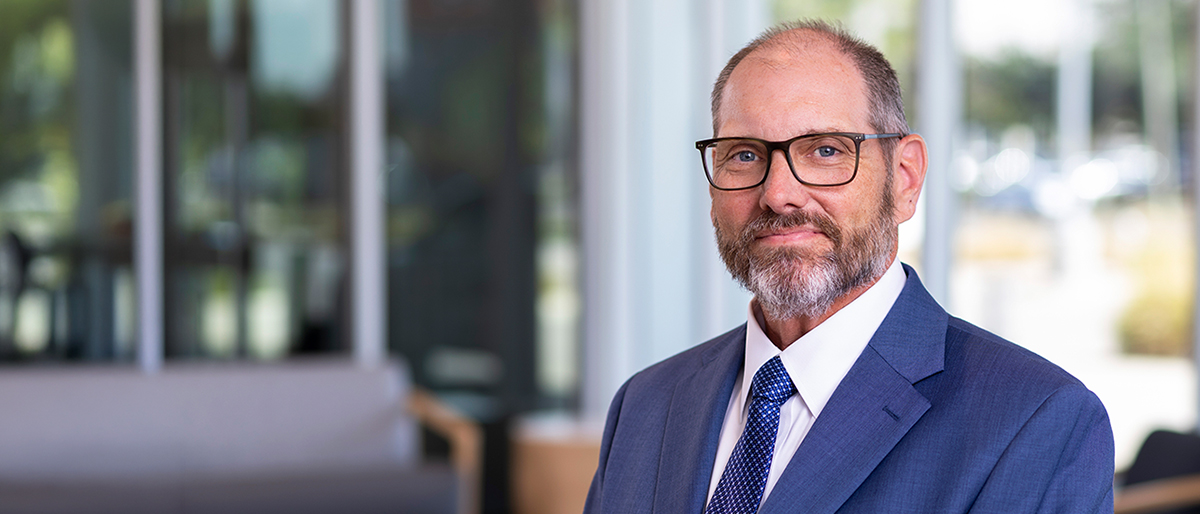
Wayne Young, M.B.A., M.Ed., recently joined UT Southwestern as Vice President and Chief Executive Officer of the Texas Behavioral Health Center (TBHC), the first state psychiatric hospital in Dallas-Fort Worth.
It’s an opportunity he has been working toward for the last 30 years – first as a counselor and then as one of the state’s most respected behavioral health administrators.
“The chance to be in on the ground floor of this behavioral health center and help build its culture from the ground up is really exciting,” said Mr. Young, who also serves as Vice President of Behavioral Health Integration and Partnerships at UTSW. “TBHC merges the intellectual powerhouse that is UT Southwestern with the decades of experience the Texas Health and Human Services Commission (HHSC) has in launching and overseeing these programs at a large scale. In effect, we are marrying clinical expertise and research capabilities with solid infrastructure to deliver effective, evidence-based care to patients.”
Mr. Young oversees the full continuum of behavioral health services at TBHC, which admitted its first patients at the end of June. Together with Tarek Rajji, M.D., Chair of Psychiatry, and other UTSW and HHSC leaders, he will work quickly to expand and improve critically needed mental health services in the Metroplex.
Before joining UTSW, Mr. Young was CEO of The Harris Center for Mental Health and Intellectual and Developmental Disabilities (IDD) in Houston, where he was instrumental in the planning and delivery of care to more than 90,000 patients annually. The Harris Center also served the Harris County Jail System, the third-largest jail system in the U.S.
Prior to that, Mr. Young was Senior Vice President for Behavioral Health at JPS Health Network in Fort Worth.
“From my perspective, having a high-quality, well-run psychiatric hospital is the baseline. That’s the expectation, and I wouldn’t want anything less. But if we stop there, I think we’ll have missed a tremendous opportunity.” Wayne Young, M.B.A., M.Ed.
Mr. Young is the former Chair of the Behavioral Health Advisory Council to HHSC and a former member of HHSC’s Joint Committee on Access and Forensic Services. In 2021, the Supreme Court of Texas appointed him to the Texas Judicial Commission on Mental Health.
Beyond the professional opportunity, returning to Dallas is a homecoming for Mr. Young, who grew up here and is eager to shape one of the city and state’s most significant behavioral health initiatives. He recently took time to answer some questions for Center Times Plus about himself and his plans for TBHC.
What inspired you to pursue behavioral healthcare?
When I started college at Texas Tech, I was an architecture major. Two years in, I realized I might be a decent architect, but I didn’t have a lot of passion for it. I started considering my options. Like many people, mental health and substance use disorders have touched my life and my family. That experience led me to explore the field more seriously. I received a scholarship that allowed me to pursue some coursework, and before I knew it, I was completely immersed. I graduated with a Bachelor of Science in human development and family studies and a minor in substance abuse studies.
Then, while I worked for the Texas Tech University Health Sciences Center in the Department of Psychiatry, I was blessed with excellent mentors who saw potential in me and encouraged me to pursue a graduate degree. That led me to earn a Master of Education in community counseling. As I continued in my career, it became clear that my calling leaned toward administration, so I decided to follow that path, which ultimately led me to earn an M.B.A. in healthcare administration from the University of Dallas in 2006.
How have your personal or professional experiences influenced your philosophy and approach to this field?
My early-career work as a prevention/intervention and chemical dependency counselor really cemented my commitment to patient-centered care.
Those experiences taught me that regardless of how people enter the healthcare system – through court mandates or voluntary services – the individual receiving care should always remain at the center of the conversation. We have a responsibility to provide the best possible care and to allow them and empower them to be as much in charge of their treatment as they can be.
What is your long-term strategic vision for the Texas Behavioral Health Center?
I think that it’s important to create a strategic vision for TBHC that is developed with input from the people and organizations that are well embedded in the behavioral health system and the communities we will serve. That includes the Texas Health and Human Services Commission and Children’s Health. This hospital has been developed in partnership with them, and while there are several things I’m personally excited about, I want to make sure their perspectives, priorities, and visions are integral parts of the strategy.
From my perspective, having a high-quality, well-run psychiatric hospital is the baseline. That’s the expectation, and I wouldn’t want anything less. But if we stop there, I think we’ll have missed a tremendous opportunity.
We have so much potential to build something that is truly among the best in the nation and change the way behavioral healthcare is delivered. Through the generous support of Children’s Health, we have 92 beds dedicated to pediatric patients. That gives us an extraordinary opportunity to rethink how we provide care to children and adolescents with significant behavioral health needs and to develop a model that will have an impact well beyond our local community.
Ultimately, my vision is for TBHC to be more than a psychiatric hospital. I want it to be a critical part of a comprehensive behavioral health system – one that works collaboratively with HHSC, healthcare providers, community organizations, and other partners to make sure people receive the right care at the right time and have meaningful pathways to recovery and stability after they leave us.
What are your initial plans and priorities?
In the first year, my top priority will be to build a culture of excellence. That means recruiting and developing a strong team; creating a culture centered on high-quality, patient-centered care; and making sure everyone is aligned in our mission and our responsibility to provide the best possible psychiatric care for the community.
We have a unique opportunity to establish the foundation of an organization that will serve this community for decades to come. You only get one chance to build a culture from the ground floor, and I want to make sure we get that right. The goal is not simply to open the doors. It’s to establish a strong foundation of clinical and operational excellence and a shared commitment to our patients and our community, which will carry TBHC forward for generations.
What are the greatest needs in DFW and how do they fit into the state’s plans to improve behavioral healthcare across Texas?
I think that Dallas-Fort Worth’s behavioral health needs are not that different from any other major metropolitan areas. Frankly, there’s not a community in the country that would say it has behavioral health completely figured out. If you were to take a systemic glance across the country – not just North Texas – you would find a lack of sufficiently robust behavioral health services. The services that do exist are very good, but they’re often not broad or intensive enough to meet the needs of an entire population. As a result, individuals with behavioral health issues often disproportionately end up in criminal justice systems, unhoused, or with less desirable outcomes.
I think TBHC has an important role to play, not as a standalone solution but as a partner to strengthen the broader behavioral health system. Our academic focus and community orientation will give us an opportunity to bring together clinical expertise, research, education, and community partnerships in a way that will help us think differently about behavioral healthcare.
How will your familiarity with North Texas and its needs help you lead TBHC?
I grew up in North Texas and spent most of my life in the area. I worked for 10 years at JPS Health Network in Fort Worth, where a significant part of my role was to lead inpatient services and stay closely connected to the community. We had two inpatient facilities, of which I was the administrator. And at The Harris Center, I had the opportunity to lead one of the most robust continuums of services in the country. Many of those who leave state hospitals transition to The Harris Center where they can find ongoing care and support. While I was there, I also led behavioral health services for one of the largest jail systems in the country, giving me experience in overseeing forensic psychiatric services and competency restoration.
There aren’t many people who have had the opportunity to work across all those parts of the behavioral health system: inpatient care, community-based services, forensic behavioral health, and transitions between levels of care. I believe that this combination of experience gives me a unique understanding of the people we will serve at TBHC and, just as importantly, the system of care that surrounds them.
Endowed Title
Dr. Rajji holds the Stanton Sharp Distinguished Chair in Psychiatry.