

Artificial Intelligence Research
Artificial intelligence (AI) is revolutionizing biomedical research. At UT Southwestern, our focus is on advancing, validating, and scaling these approaches into ethical tools that seamlessly integrate with existing biomedical and health care workflows. Our researchers are at the forefront of translating emerging AI tools into applications that improve clinical care, enhance education, and accelerate biomedical discovery.
Research Highlights
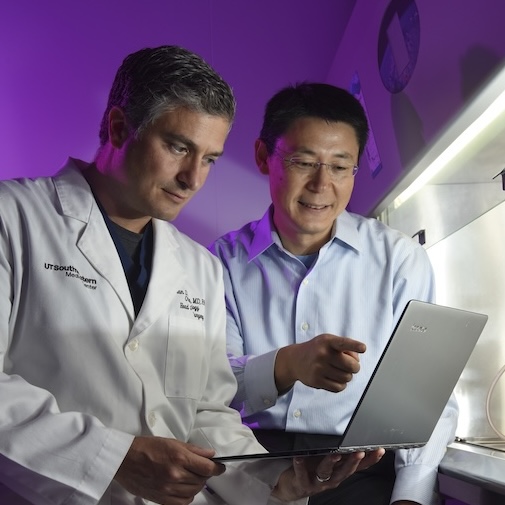
A breakthrough imaging technology is lighting the way to a new era in cancer treatments. A fluorescent nanoprobe developed by the Gao laboratory uses innovative pH-sensitive technology to distinguish cancer cells from healthy tissue, helping surgeons achieve more precise tumor removal while preserving normal cells. By bringing together expertise in chemistry, biomedical engineering, and surgical oncology, the team is now exploring how this technology could power AI-driven surgical guidance and training tools, as well as next-generation nanovaccines that stimulate the immune system to target cancer metastases.
The Medical Artificial Intelligence and Automation (MAIA) Lab is dedicated to developing and deploying advanced AI technologies that address real clinical problems and improve patient care. The team focuses on creating AI solutions that can be translated directly into safe and effective tools for everyday use in radiation oncology and many other clinical settings. The collaborative nature of the MAIA Lab allows it to support multidisciplinary research and education, bringing together researchers, clinicians, and industry partners to jointly harness AI to improve healthcare.
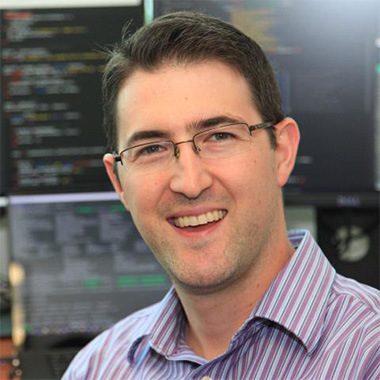
Dr. Jamieson, an Assistant Professor in the Lyda Hill Department of Bioinformatics, is reimagining how future physicians are trained using cutting-edge AI to model, evaluate, and enhance the human elements of clinical care. His lab builds advanced AI models that integrate video, audio, and text data to identify behavioral and linguistic markers of effective communication and diagnostic reasoning and convert them into useful, real-time feedback to trainees.
Campus Stories and Blogs
Latest News Releases

AI Funding
NAIRR Pilot Deep Partnerships
The National Artificial Intelligence Research Resource Pilot is seeking applications for 'Deep Partnership' proposals leveraging state of the art models for health, molecular and materials discovery. The NAIRR Pilot aims to connect U.S. researchers and educators to computational, data, and training resources needed to advance AI research and research that uses AI.
Resources

UT REAL Health AI is a systemwide initiative to responsibly accelerate artificial intelligence in health. By connecting expertise across UT institutions, UT REAL Health AI is building a coordinated ecosystem to improve patient care and safety, strengthen clinician efficiency, advance research, and prepare the workforce for an AI-enabled future.

The Lyda Hill Department of Bioinformatics seeks to provide the innovative analytic approaches needed to understand complex data. Our Department is home to theoreticians and experimentalists alike, who share a passion for the scientific exploration of uncharted territory in biomedicine through mathematical formalism and computation.

BioHPC at UT Southwestern provides a comprehensive, cloud-based platform that enables researchers to perform advanced computational work.
The BioHPC development team supports users at every level, handling infrastructure growth, system maintenance, and direct collaboration on computational projects. Our mission is to lower the barriers to high-performance computing and empower all UTSW researchers to efficiently analyze complex data and accelerate discovery.
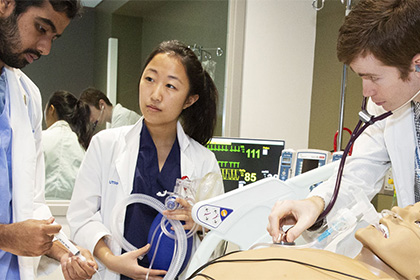
As one of the largest state-of-the-art simulation facilities in the nation, UT Southwestern Medical Center’s Simulation Center creates real-life environments through cutting-edge technologies, including artificial intelligence and virtual reality to to expand the scope and quality of its training programs for medical students, residents, health care providers and other learners.

The Innovation Hub works to turn groundbreaking research from UTSW clinicians and scientists into sustainable companies. Our aim is to act as a bridge between groundbreaking scientific research and real-world patient solutions.